Abstract
|
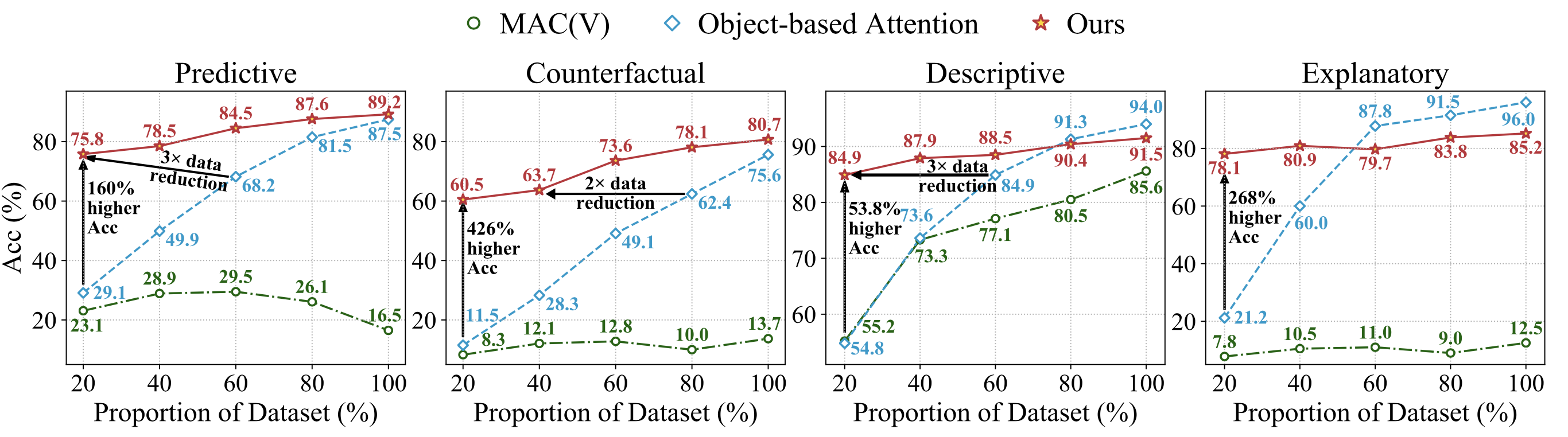
Understanding and reasoning about objects’ physical properties in the natural world is a fundamental challenge in artificial intelligence. While some properties like colors and shapes can be directly observed, others, such as mass and electric charge, are hidden from the objects’ visual appearance. This paper addresses the unique challenge of inferring these hidden physical properties from objects’ motion and interactions and predicting corresponding dynamics based on the inferred physical properties. We first introduce the Compositional Physical Reasoning (ComPhy) dataset. For a given set of objects, ComPhy includes limited videos of them moving and interacting under different initial conditions. The model is evaluated based on its capability to unravel the compositional hidden properties, such as mass and charge, and use this knowledge to answer a set of questions. We evaluate state-of-the-art video reasoning models on ComPhy and reveal their limited ability to capture these hidden properties, which leads to inferior performance.
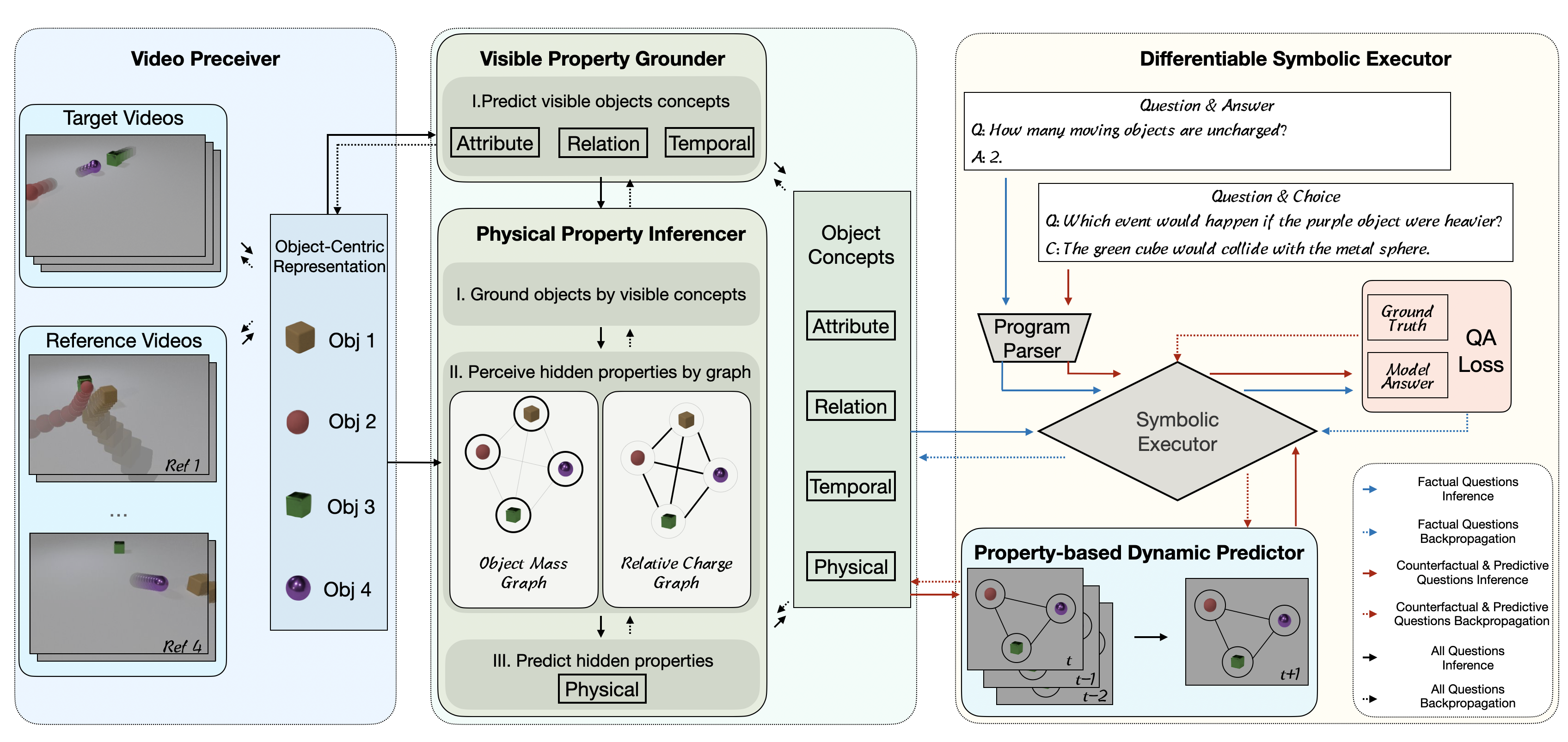
We also propose a novel neuro-symbolic framework, Physical Concept Reasoner (PCR), that learns and reasons about both visible and hidden physical properties. Leveraging an object-centric representation, PCR utilizes videos and the associated natural language to infer objects’ physical properties without dense object annotations. It incorporates property-aware graph networks to approximate the
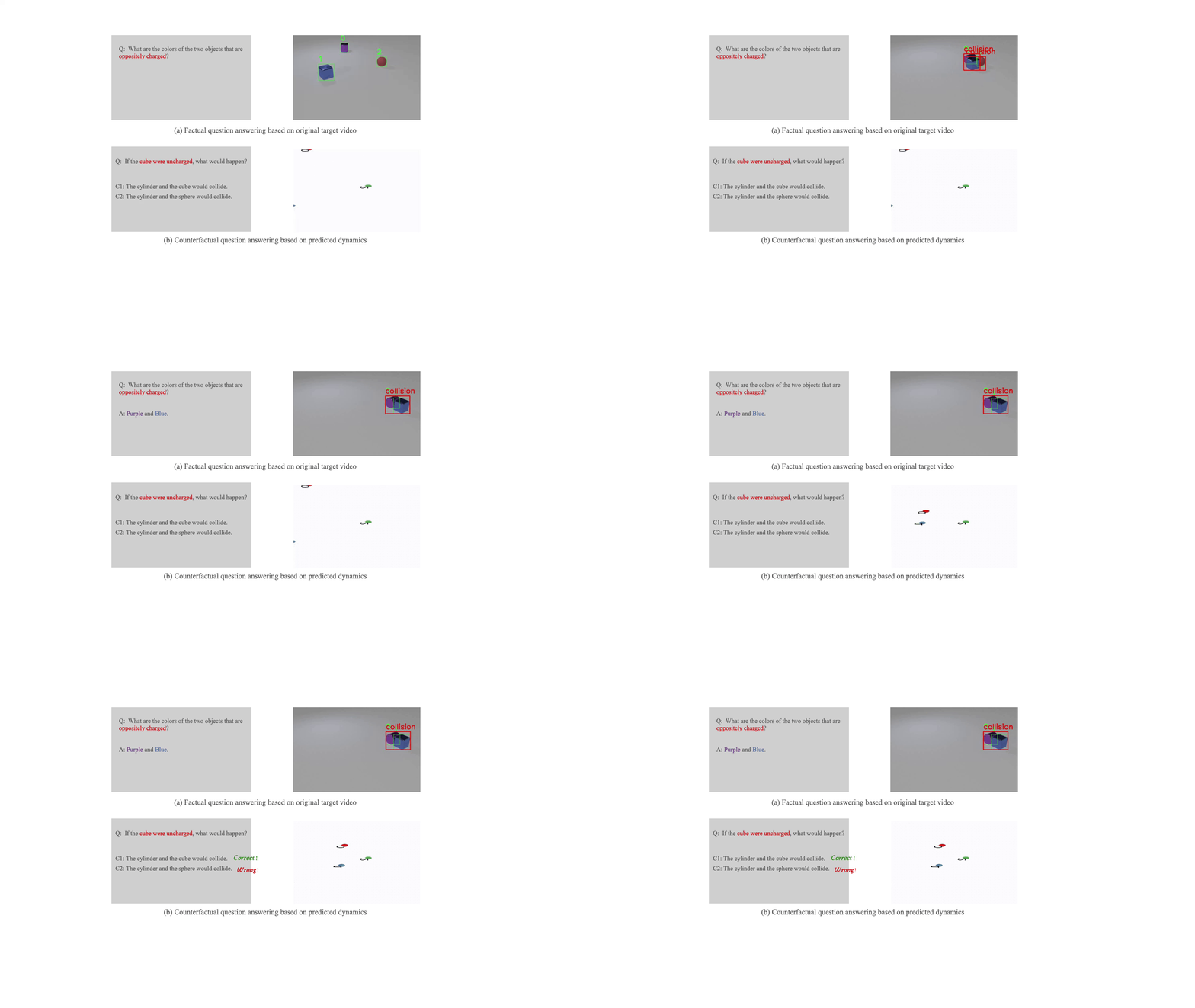
dynamic interactions among objects. Furthermore, PCR employs a semantic parser to convert questions into semantic programs, and a program executor to execute the programs based on the learned physical properties and dynamics. After training, PCR demonstrates remarkable capabilities. It can detect and associate objects across frames, ground visible and hidden physical properties, make future and ounterfactual predictions, and utilize these extracted representations to answer questions. We hope the proposed ComPhy dataset and the PCR model present a promising step towards more comprehensive physical reasoning in AI systems.
|
Resources
@inproceedings{ding2021dynamic,
author = {Ding, Mingyu and Chen, Zhenfang and Du, Tao and Luo, Ping and Tenenbaum, Joshua B and Gan, Chuang},
title = {Dynamic Visual Reasoning by Learning Differentiable Physics Models from Video and Language},
booktitle = {Advances In Neural Information Processing Systems},
year = {2021}
}